Showing posts with label Philippine stamp. Show all posts

Monday, December 5, 2016

Philippine Stamp: Intramuros


Intramuros (lit. within the walls) is the historic centre and oldest district Manila, Philippines. It is also called the Ciudad Murada (Walled City) because of its most famous feature: a nearly three-mile-long circuit of massive stone walls and fortifications that almost completely surrounds the entire district. At the time of the Spanish Colonial Period, it was synonymous to the city of Manila itself. It was the seat of government when the Philippines was a component realm of the Spanish Empire. Districts beyond the walls were referred as the extramuros (lit. outside the walls) of Manila.

Sunday, January 3, 2016

Philippine Stamp: Bangko Sentral ng Philippinas 25th Anniversary


The Bangko Sentral ng Pilipinas (BSP) (lit. Central Bank of the Philippines) was inaugurated on January 3, 1949 with with Miguel Cuaderno, Sr. as first governor. 

On July 3, 1993, pursuant to the provision of Republic Act 7653 or the New Central Bank Act of 1993, the Bangko Sentral ng Pilipinas was granted fiscal and administrative autonomy.

Thursday, August 29, 2013

Philippine Stamp: Murex Shell (Murex sp.)


Murex is a genus of medium to large sized predatory tropical sea snails. These are carnivorous marine gastropod molluscs in the family Muricidae, commonly called "murexes" or "rock snails".

Murex is solely found in the Indo-Pacific region.


Wednesday, February 6, 2013

Philippine Stamp: National Gem (South Sea Pearls)


The South Sea pearl is the unofficial national gem of the Philippines.

South Sea pearls are produced by the Pinctada maxima, a species of pearl oyster in the family Pteriidae. Pinctada maxima, the largest pearl oysters in the world, are found in the Philippines, Australia and Fiji.

The South Sea pearl is also featured in the reverse side of the Philippine one thousand peso bill of the New Generation Banknote Series.

Tuesday, October 30, 2012

Philippine Stamp: Mary Knoll College 50th Anniversary


Mary Knoll College was established in 1926 when the Archbishop of Manila, then Reverend Michael O’ Doherty, requested the Sisters of the Maryknoll Congregation in New York to initiate a teacher-training program for women in the Philippines. Originally named Malabon Normal School, the school’s first site was a remodeled Augustinian Convent in Malabon, Rizal. 

In 1953, the Malabon Normal School moved to the college’s present location in Diliman, Quezon City and was officially renamed Mary Knoll College. 

In 1989, after a series of consultations, Maryknoll College was renamed Miriam College.

Sunday, July 15, 2012

Philippine Stamp: National Bird (Philippine Eagle)


The Philippine Eagle (Pithecophaga jefferyi) is a critically endangered eagle species endemic to the forests of the Philippines. 

The Philippine Eagle was discovered British naturalist John Whitehead in 1896 and was named after his father Jeffery Whitehead. The bird was originally called Monkey-eating Eagle, due to the previous belief that the eagle exclusively preyed on monkeys, hence the generic name Pithecophaga. 

On July 15, 1995, Fidel V. Ramos, then President of the Philippines, signed Proclamation No. 615, declaring the Philippine eagle as the national bird.

Saturday, March 3, 2012

Philippine Stamp: Aerides lawrenciae orchid


Aerides lawrenciae is a species of plant in the Orchidaceae family. It is endemic to the Philippines. Its natural habitat is subtropical or tropical moist lowland forests. It is threatened by habitat loss.

Growing in brightly lit environments at low altitude, on the islands of Mindanao and Cebu, Aerides lawrenciae is a robust species up to 5 ft (1.5 meters) tall. It sometimes becomes pendulous. The inflorescence has up to 30 strongly fragrant flowers, each about 4 cm across. 

Wednesday, February 29, 2012

Philippine Stamp: Elpidio Quirino


Elpidio Rivera Quirino (November 16, 1890 – February 29, 1956) was a Filipino politician, and the sixth President of the Philippines.

A lawyer by profession, Quirino entered politics when he became a representative of Ilocos Sur from 1919 to 1925. He was then elected as senator from 1925–1931. In 1934, he became a member of the Philippine independence commission that was sent to Washington, D.C., which secured the passage of Tydings-McDuffie Act to American Congress. In 1935, he was also elected to become member of the convention that will write the draft of then 1935 constitution for the newly-established Commonwealth. At the new government, he served as secretary of the interior and finance under Manuel Quezon's cabinet.

After the war, Quirino was elected vice-president in 1946 election, consequently the second and last for the Commonwealth and first for the third republic. After the death of the incumbent president Manuel Roxas in 1948, he succeeded the presidency. In what was claimed to be a dishonest and fraudulent 1949 presidential election, he won the president's office under Liberal Party ticket, defeating Nacionalista vie and former president José P. Laurel as well as fellow Liberalista and former Senate President José Avelino.

Saturday, February 25, 2012

Philippine Stamp: People Power


The People Power Revolution (also known as the EDSA Revolution and the Philippine Revolution of 1986) was a series of popular demonstrations in the Philippines that occurred in 1983-86. The methods used amounted to a sustained campaign of civil resistance against regime violence and electoral fraud. This case of nonviolent revolution led to the departure of President Ferdinand Marcos and the restoration of the country's democracy.

The majority of the demonstrations took place on a long stretch of Epifanio de los Santos Avenue, more commonly known by its acronym EDSA, in Metropolitan Manila from February 22–25, 1986 and involved over two million Filipino civilians as well as several political, military, and including religious groups led by Cardinal Jaime Sin, the Archbishop of Manila. The protests, fueled by the resistance and opposition from years of corrupt governance by Marcos, culminated with the departure of the dictator from Malacañang Palace to the United States state of Hawaii. Corazon Aquino was proclaimed as the legitimate President of the Philippines after the revolution.

Tuesday, February 14, 2012

Philippine Stamp: Happy Valentine 1996


valentine (plural valentines)

1. An expression of affection, especially romantic affection, usually in the form of greeting card, gift, or message given to a person the object of affection, especially on February 14th.
        Such an extravagant valentine was unexpected.

2. A person to whom a valentine is given or received, especially on February 14th.
       Won't you be my valentine? 

Sunday, December 25, 2011

Philippine Stamp: Pasko '88


A paról is an ornamental, star-shaped Christmas lantern from the Philippines. It is traditionally made out of bamboo and paper and comes in various sizes and shapes, but generally the basic star pattern remains dominant.

The design of the paról evokes the Star of Bethlehem that guided the Three Kings to the manger. It also symbolizes the victory of light over darkness and the Filipinos' hope and goodwill during the Christmas season.

Friday, August 26, 2011

Philippine Stamp: 1972 Munich Olympics - Olympic Torch


The 1972 Summer Olympics, officially known as the Games of the XX Olympiad, was an international multi-sport event held in Munich, West Germany, from August 26 to September 11, 1972. The killings of 11 Israeli athletes by Palestinian gunmen in an event known as the Munich massacre took center stage.

The 1972 Summer Olympics were the second Summer Olympics to be held in Germany, after the 1936 Games in Berlin, which had taken place under the Nazi regime.

Saturday, May 28, 2011

Philippine Stamp: APO Philatelic Society Silver Jubilee


The Amateur Philatelists Organization or APO (forerunner of the APO Philatelic Society) was organized on May 28, 1950 by Messrs. Francisco Arcebal, Carlos Licup, and Mamerto Gallardo.

The first organizational meeting of the APO was held on June 11, 1950 with twelve members in attendance.

Tuesday, April 19, 2011

Philippine Stamp: Joseph Ejercito Estrada


Joseph "Erap" Ejercito Estrada (born Jose Marcelo Ejercito on April 19, 1937) was the 13th President of the Philippines, serving from 1998 until 2001.

Sunday, October 24, 2010

Philippine Stamp: Rafael Palma


Rafael Palma was a Filipino politician, reporter, writer, educator and a famous mason in Philippines. He also became the fourth President of the University of the Philippines.

Thursday, October 21, 2010

Philippine Stamp: 75th Anniversary of the National Archives of the Philippines


The Treaty of Paris (December 10, 1898) established the Office of Archives (formerly Spanish Division of Archives) under the American authority which stipulated the relinquishment or cession of documents from Spanish to American authorities and provided for the preservation of documents whether they may be in Spain or in the Philippines.

On October 21, 1901, the Philippine Commission Act No.  273 established the Bureau of Archives under the Department of Public Instructions (now Department of Education).

The Bureau of Archives was reduced into a division on November 1, 1915 by the Reorganization Act No. 1407.

February 4, 1916; the Commonwealth Act No. 2572 integrated the Division of Archives with Philippine Library and Museum.

The Bureau of Records Management (BRM) for coordinated management of official documents, was created on February 14, 1956 through the Reorganization Plan No. 8-A.

March 14, 1958; the Executive Order No. 290 provided for the organization of the Bureau of Records Management under the Department of General Services with the Division of  Archives as one of its divisions.

On September 24, 1972; the Presidential Decree No. 1 reorganized the Executive Branch and renamed the BRM to Records Management and Archives Office (RMAO). The RMAO was re-classified as a cultural agency attached to the Department of Education, Culture and Sports (DECS) by the Executive Order No. 285  on July 25, 1987.

On March 15, 1999, Executive Order No. 80 transferred RMAO to the Office of the President attached to the National Commission for Culture and the Arts (NCCA)  for program and policy coordination.

Finally on May 21, 2007, the Republic Act No. 9470 strengthened the system of management and administration of archival records, establishing for the purpose, the National Archives of the Philippines.

Saturday, May 15, 2010

Tuesday, January 12, 2010

Philippine Stamp: Col. Jesús Villamor


Jesús Antonio Villamor was a Filipino pilot who fought the Japanese in World War II.

For leading his squadron and for his two confirmed kills, Villamor was twice cited by the United States Army for bravery, receiving the Distinguished Service Cross for actions on December 10, 1941 and an Oak Leaf Cluster in lieu of a second award of the Distinguished Service Cross (DSC) for actions on December 12, 1941, making him the only Filipino to receive the DSC twice.

For his bravery as a pilot and ingenuity as an intelligence officer, President Ramón Magsaysay awarded Lieutenant Col. Villamor the Medal of Valor, the highest Philippine military bravery decoration, on January 21, 1954. The Philippine Air Force's principal facility in Metro Manila which was first known as Nichols Field then later Nichols Air Base was renamed Col. Jesús Villamor Air Base in his honor.

Wednesday, December 9, 2009

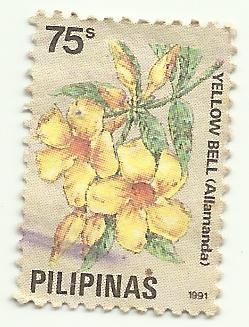
Philippine Stamp: Yellow Bell (Allamanda)


Allamanda, also known as Yellow Bell, Golden Trumpet or Buttercup Flower, is a genus of tropical shrubs or vines belonging to the dogbane family (Apocynaceae).

The genus Allamanda is native to South and Central America. Their year-round production of large, bright flowers have made the Allamanda popular ornamentals.

A woody, evergreen shrub with vigorous growth, Allamanda may reach a free-standing height of 2 metres or more. The leathery leaves are lancelike, pointed, and may either be opposite or in whorls of three or four. The yellow, trumpet-shaped flowers are 5-7.5 centimetres in diameter; cultivated forms tend towards larger blooms which may also be white, purple, pink or orange in colour. Their scent may be described as delicate and fruity.

Tuesday, December 8, 2009

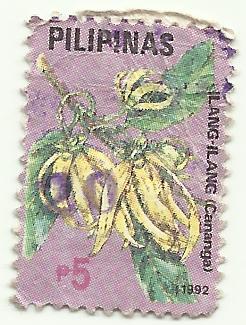
Philippine Stamp: Ilang-ilang (Cananga)


Cananga odorata, commonly called Ylang-ylang, cananga tree, Ilang-ilang, fragrant cananga, Macassar-oil plant or perfume tree, is a tree valued for its perfume. The essential oil derived from the flowers is used in aromatherapy. Cananga odorata is a fast-growing tree of the custard-apple family, Annonaceae.

In the Philippines, its flowers, together with the flowers of the sampaguita, are strung into a necklace (lei) and worn by women and used to adorn religious images.